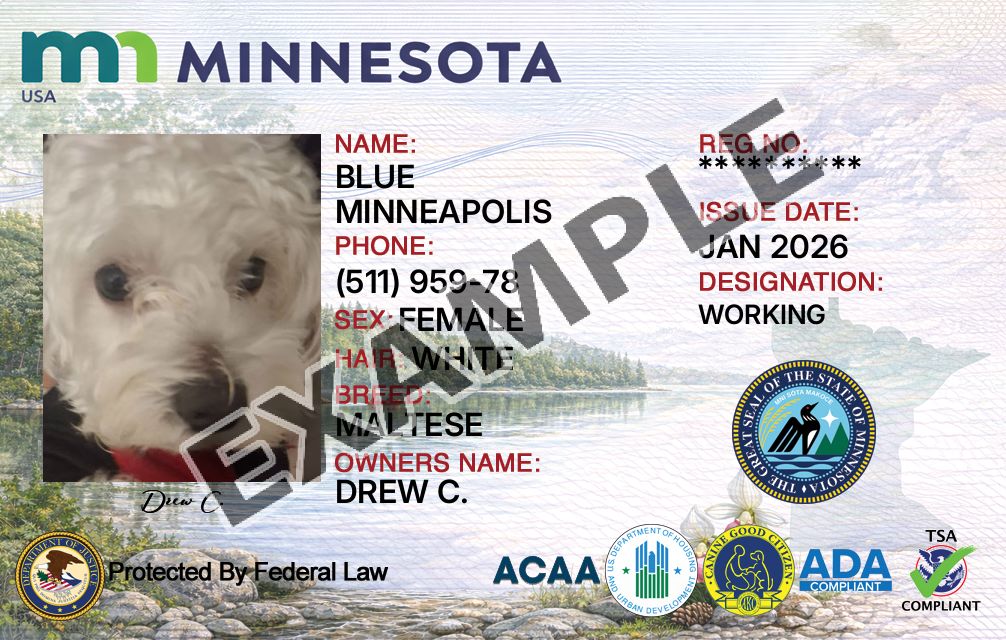
Registering Your Dog in Watonwan County, Minnesota (Service Dog or Emotional Support Dog)
If you’re searching where do I register my dog in Watonwan County, Minnesota for my service dog or emotional support dog, the key thing to know is that dog licensing is usually handled locally (often by a city office within the county), while service dog and emotional support animal (ESA) status comes from different laws and rules—not from a dog license.
This page explains how a dog license in Watonwan County, Minnesota typically works, what rabies documents you’ll likely need, and which official offices residents commonly contact for licensing, animal control, or rabies enforcement—especially if you live in or near the county’s cities.
Where to Register or License Your Dog in Watonwan County, Minnesota
Because licensing can be handled at the city level (and rules vary by location), the offices below are examples of official places residents may contact to ask where to register a dog in Watonwan County, Minnesota, how to obtain tags, and how rabies documentation is handled. If you live outside city limits, ask your local city hall or township office which agency issues licenses in your area.
City of St. James — City Hall (Dog Licensing)
- Mon–Thu: 8:30am – 5:00pm
- Fri: 8:30am – 4:00pm
City of St. James — Animal Control (Dispatch)
City of Madelia — City Hall (Pet Licensing / Animal Control Information)
- Mon–Thu: 8:00am – 5:00pm
- Fri: 8:00am – 4:00pm
Watonwan County Sheriff’s Office (County Law Enforcement / Animal-Related Enforcement Questions)
Overview of Dog Licensing in Watonwan County, Minnesota
What “registering your dog” usually means
In everyday terms, “registering” a dog usually means obtaining a local license (and tag) through the government office that administers animal licensing where you live. In Watonwan County, this commonly means your city (if you live inside city limits), but may involve different procedures for residents outside city boundaries.
Why local licensing exists (and what it does)
A local dog license typically supports three practical goals:
- Rabies control: licensing processes commonly require proof of current rabies vaccination.
- Identification: tags help return lost dogs to their owners faster.
- Enforcement: animal control or law enforcement can verify whether a dog is properly licensed where required.
Rabies vaccination requirements
While local rules can vary, Minnesota’s rabies control framework relies on vaccination certificates completed by a veterinarian. In practice, licensing offices typically ask for a rabies vaccination record (certificate or vet documentation) showing the date given and vaccine details. If your dog’s rabies vaccination is not current, you may need to vaccinate first before the office issues a license and tag.
How Dog Licensing Works Locally in Watonwan County, Minnesota
Step 1: Confirm who issues licenses for your address
The most common first step is to determine whether your city issues the license (for addresses inside city limits) or whether another local unit of government does. This is why the “where to register a dog in Watonwan County, Minnesota” answer often starts with your city hall.
Step 2: Gather documents (especially rabies proof)
Most licensing offices will ask for proof of current rabies vaccination. Keep a copy of your rabies certificate or vet-provided vaccination record. If your dog is newly acquired, newly moved into the area, or newly vaccinated, ask whether the office requires a paper certificate, an emailed record, or a copy printed at the counter.
Step 3: Apply and pay the licensing fee
Fees and timing can be different depending on the city. Some cities issue licenses annually, while others may issue longer-term or “lifetime” licensing. For example, St. James publicly describes a lifetime dog license with proof of vaccination, and Madelia describes licensing requirements with rabies proof and fees. Always confirm what applies to your specific address and dog.
Step 4: Attach tags and keep records
Once licensed, you’ll typically receive a tag to attach to your dog’s collar. Keep your rabies certificate and licensing information accessible, especially if you travel, board your dog, or need to show proof for a lease, city ordinance question, or an animal control issue.
If you live outside city limits
If you’re outside St. James or Madelia city limits (or outside any city), licensing and enforcement may involve township rules or county-level guidance. In those cases, call an official local office (often city hall for the nearest city, your township office if available, or the county sheriff for direction) and ask, “Which office issues dog licenses for my address?”
Service Dog Laws in Watonwan County, Minnesota
Service dog definition (public access)
Under the ADA’s public access rules, a service animal is generally a dog that is individually trained to do work or perform tasks for a person with a disability. Comfort or emotional support by itself is not a task under the ADA service animal definition.
Do service dogs need to be “registered” with the government?
For public access purposes, the ADA does not require a government-issued registration or a special ID card for service dogs. However, local health and licensing rules can still apply, which is why people often still obtain a local dog license in Watonwan County, Minnesota (and keep rabies vaccination proof current) even when the dog is a service dog.
What businesses or offices may ask (and what they usually can’t)
When it is not obvious that a dog is a service dog, staff are typically limited to asking questions like whether the dog is required because of a disability and what work or task the dog has been trained to perform. In general, they cannot require medical documentation, demand special ID, or require a demonstration of the dog’s task.
Licensing vs. service dog status
A dog license is not “service dog paperwork.” A dog license is a local identification and rabies-compliance tool. Service dog status is based on disability law and training. It’s normal for both to exist at the same time: the dog can be a trained service dog and also be locally licensed.
Misrepresentation warning
Minnesota law prohibits intentionally misrepresenting an animal as a service animal in places of public accommodation to obtain rights or privileges reserved for service animals. If you’re unsure whether your dog qualifies as a service dog under the ADA, focus on the training and task requirements rather than online “registration” claims.
Emotional Support Animal Rules in Watonwan County, Minnesota
What an emotional support animal is (and where ESAs matter most)
An emotional support animal (ESA) is generally an animal that provides therapeutic benefit (comfort, support, reduced symptoms) related to a disability. ESA rules most often come up in housing—for example, requesting a reasonable accommodation in a rental property.
ESAs are not service dogs under the ADA
ESAs do not automatically have the same public-access rights as service dogs under the ADA. That means an ESA generally isn’t allowed everywhere pets are prohibited just because it provides emotional support.
Does an ESA need a “registration” or license to be valid?
ESA status for housing accommodations is not created by buying an online certificate. Also, Minnesota guidance indicates that service or emotional support animals are not required to be “registered” under the Minnesota Human Rights Act for housing purposes. That said, you may still need a local dog license where required and you should keep rabies vaccinations current to meet local health and safety rules.
Practical tip: keep your dog licensed anyway
Even if your dog is an ESA, it can still be subject to local ordinances such as licensing, leash rules, nuisance rules, and vaccination requirements. Keeping your dog properly licensed can prevent avoidable problems with animal control or during a move.
Frequently Asked Questions
Start with your local city hall if you live inside city limits (for example, St. James or Madelia). If you’re outside city limits, ask an official office which authority issues licenses for your address. This is the most reliable way to answer where to register a dog in Watonwan County, Minnesota without relying on third-party services.
No. A local license is about identification and rabies compliance. A service dog’s legal status comes from disability laws and the dog’s task training. A dog license in Watonwan County, Minnesota can still be required even when the dog is a legitimate service dog.
Most licensing offices commonly require proof of current rabies vaccination and payment of a licensing fee. Requirements and fees vary locally, so confirm with the office that handles the animal control dog license Watonwan County, Minnesota processes for your address.
Generally, no. ESAs typically do not have the same public-access rights as ADA service dogs. ESA rules mainly apply to housing accommodations. Separate from access rights, your dog may still need to follow local licensing and rabies requirements.
Ask an official local office which jurisdiction issues licenses for your specific address. If you don’t know where to start, contacting the nearest city hall or the county sheriff’s office for direction is a practical first step.